
How to Search Criminal Dockets
Missouri Case.net is the free public starting point for an Oregon County criminal docket. Basic case information is free. When the search screen offers a court or location filter, pick the 37th Judicial Circuit and Oregon County. A case number is the fastest route. A litigant-name search works when no number is at hand. A matching name alone never proves the hit is the right Oregon County case.
Check the case header first. It confirms the court, category, filing date, and case status. Read this before you read the docket sheet. From there, open Docket Entries and Scheduled Hearings & Trials. One case can carry several settings. A later notice, order, reset, or continuance can replace an older hearing date. If the online docket looks incomplete, or a current setting needs verification, the Oregon County Circuit Clerk can confirm the lawful local route.
- Open the official Case.net service and choose Case Number Search, Litigant Name Search, Filing Date Search, or Scheduled Hearings & Trials Search.
- Choose 37th Judicial Circuit and Oregon County if the available filters permit a location selection, then use the defendant name, date range, citation number, or court number.
- Check the case header before opening the result. Confirm that the case type, court, and filing information fit the Oregon County matter being sought.
- Read Docket Entries in date order and compare the newest setting or signed order with earlier entries. Linked entries may open a document when public access permits.
- For a copy, a same-day question, or a record that does not appear, contact the Circuit Clerk instead of treating a search result as the official certified record.
Note: A no-result search can reflect a spelling issue, a different court route, a new entry, an archived file, or a lawful access restriction.
Oregon County Criminal Docket Codes
Missouri Court Operating Rule 4 builds every case number from the same statewide parts. Those parts are a year, a location identifier, a category, a sequence, and a subcase code. One example of the format is 24-OR-CR00001-01. Copy punctuation and the local identifier straight from the actual court document. Do not guess them. Every criminal defendant gets a separate file number. In qualifying traffic matters, a uniform citation number can also serve as the file number.
Category codes offer a quick first clue about where an Oregon County record belongs. They do not decide whether a document is public. For the entered category, the setting, and the case status, the docket sheet and case header remain the reliable sources.
- CR
- Criminal case category in Missouri's statewide construct.
- TR
- Traffic category, often tied to a citation or backer sheet.
- MU
- Municipal ordinance category, which can matter for a Thayer city case.
- TC
- Treatment court category; treatment records can be confidential even when an underlying case has public activity.
What a Criminal Docket Shows
Court Operating Rule 4 says a docket sheet from the approved system identifies the filing county or city, the case type, case number, parties, attorneys of record, filed documents, and judicial action. An Oregon County criminal docket can also carry a charge, a bond event, an arraignment, a motion, a setting, a sentence, a warrant or failure-to-appear event, and the recorded disposition. What the public sees varies with case type and security.
| Case number | The unique Oregon County court number or a qualifying citation number, such as 24-OR-CR00001-01. |
|---|---|
| Charge and parties | The filed offense, case style, State or municipality, and the defendant assigned to that case file. |
| Docket entries | Chronological filings and actions, including charging papers, warrants, motions, orders, and hearing notices. |
| Settings | Entered date, time, location, judge, and setting type when those details are available in the record. |
| Disposition | An entered outcome such as guilty, dismissal, nolle prosequi, sentence, or another authorized result. |
The official rule sets out the recordkeeping framework that this Oregon County criminal docket illustration follows.
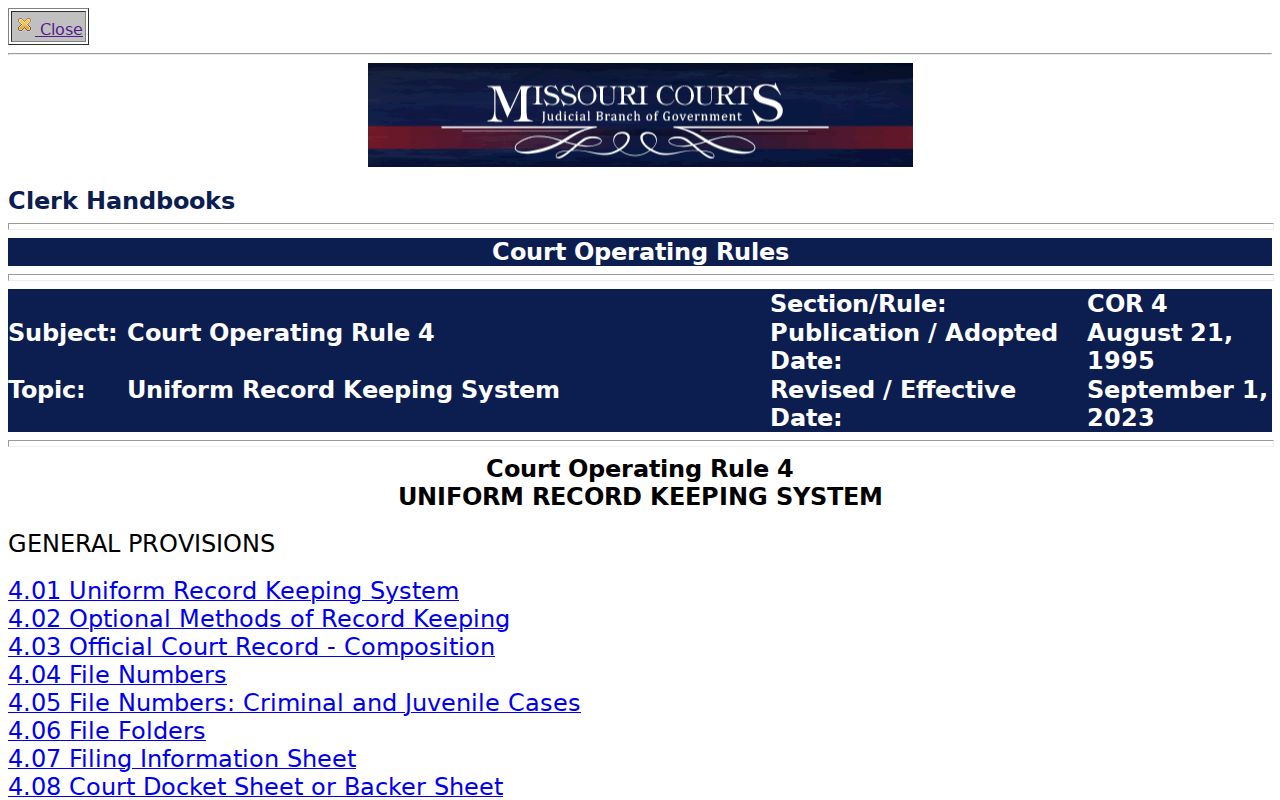
The rule also helps separate the chronological list of docket entries from the documents that may sit behind each entry.
Oregon County Criminal Docket Numbers
Missouri's uniform recordkeeping system gives each defendant a separate file number. So an Oregon County criminal docket with multiple defendants can show related numbers. It will not show one shared case file. Start with the number printed on the court material. Then use the case header to confirm the defendant, court, filing date, and category. Only then should related activity be treated as part of the same record.
That separation keeps mattering after the first filing. One defendant's Oregon County docket can show a different setting, plea, disposition, or post-judgment event than a codefendant's. In a docket search, open each listed case number. Read the entries on their own. A shared charge description or a shared court day does not make every entry apply to every defendant.
Oregon County Criminal Docket Access
Case.net serves the public as a docket reader. The Missouri eFiling System is the statewide filing and secured case-management environment. A public Docket Entry link opens an attached document only when that document is public. The user's access level must also allow it. Missouri Courts' File Viewer help notes that a non-hyperlinked entry may have no attachment. It may simply be unavailable to that user. The tag ECASE marks an electronic case record. It does not mean every document is available remotely.
When an Oregon County entry is new, unlinked, or unclear, take the clerk route. The Circuit Clerk keeps the local circuit docket and the case file. Court staff can log a public user onto courthouse access equipment for public cases. The counter can explain whether inspection, a plain copy, or a certified copy is the proper next step. No online screen or Case.net notice counts as a clerk-certified record.
| Access route | Best use | Limit |
|---|---|---|
| Case.net | Case header, public docket entries, and scheduled hearings. | Security settings can limit documents and recent activity may need confirmation. |
| Courthouse public terminal | Public documents available through staff-assisted courthouse access. | Ask the Circuit Clerk about current terminal procedures. |
| Circuit Clerk | Current-entry confirmation, paper file access, copies, and certification. | The clerk gives procedural information, not legal advice. |
Stages on a Criminal Docket
An Oregon County criminal docket opens with a filing. That filing may be a complaint, information, indictment, or uniform citation. Expect early entries on custody, warrants, bond, arraignment, counsel, and a plea. Felony cases may add a preliminary hearing, a waiver, a bind-over, or a certification. After that the matter moves forward in circuit court. Read each entry's date alongside its description. One later order can quietly change what an earlier event means in practice.
Pretrial entries bring motions, status dates, discovery settings, and the occasional continuance or reset. From there the court docket sheet shows a plea or trial event, the disposition, and any sentence or post-judgment activity. Be careful with bond lines. A forfeiture is a financial judgment, not a verdict of guilt. A warrant or probation-violation entry stands on its own too. Neither one is the final result of the original charge.
Docket flow: Filing → Arraignment → Pretrial → Plea or Trial → Disposition → Sentencing
Wednesday Oregon County Criminal Dockets
Under the published local rule, Oregon County Division II criminal court sits each Wednesday at 9:00 a.m. That standing court day helps when you run an Oregon County criminal docket search. It is useful when you spot a criminal setting on a case. It is not a guarantee. Judges can specially set, continue, or remove a matter. So the newest case entry or notice controls the actual date for that case.
For location, the Sheriff points to the second-floor Associate Courtroom. That is the usual spot for arraignments and preliminary hearings. Felony cases are normally decided in the Circuit Courtroom instead. Both sit within the Oregon County Courthouse. Check the current case record or confirm with the clerk before assuming a courtroom from the charge alone.
Note: For a Thayer ordinance or municipal traffic case, verify the city route because its monthly municipal session is distinct from the Oregon County criminal day.
Oregon County Criminal Treatment Dockets
The published Oregon County court schedule lists Treatment Court on the first and third Wednesdays at 3:30 p.m. An Oregon County criminal docket may show the public side of an underlying case. A referral or status entry is an example. The treatment program itself keeps its own confidentiality limits. So treat the setting as one court event in the Oregon County criminal docket, not as a public release of program evaluations or treatment reports.
Court Operating Rule 4 makes drug-court records confidential. A public Oregon County criminal docket can still reveal the underlying case number. Any lawfully visible entry may appear too. For anything beyond that public layer, ask the Circuit Clerk which portion of the record may be inspected rather than requesting confidential treatment material.
Which Court Holds Criminal Dockets
Oregon County belongs to the Missouri Circuit Court, 37th Judicial Circuit, Oregon County. Missouri runs a unified circuit-court system. The Oregon County Circuit Clerk serves as the local docket office for both circuit and associate work, with no separate county criminal clerk. Felonies stay inside the circuit system. Preliminary felony work can appear in the associate division first. State misdemeanors and serious traffic cases also travel the associate or circuit criminal docket route.
Municipal ordinance matters need one extra check. The current local rules place Thayer Municipal Court at City Hall for city ordinance and municipal traffic business. A municipal case that goes to trial de novo transfers into the circuit or associate division. It also picks up a new circuit case number. Alton and Koshkonong offer no separate official criminal docket portal.
| Oregon County matter | Likely docket path | Search point |
|---|---|---|
| Felony or state misdemeanor | 37th Circuit circuit or associate criminal work. | Case.net, then the Circuit Clerk. |
| Preliminary felony stage | Associate courtroom activity before later circuit adjudication. | Case number and latest docket entry. |
| Thayer municipal citation | Thayer Municipal Court, with a possible later circuit transfer. | Citation, city court contact, then Case.net if entered. |
Oregon County Criminal Docket Resets
A reset or continuance is not a dismissal. Local Rule 34.2 sends criminal continuance practice to the civil rule. Under that rule, a continuance requires the court's agreement. It is not just a deal between counsel. On an Oregon County criminal docket, weigh an earlier setting against the newest notice of hearing, continuance, reset, or signed order. The last hearing date shown can be stale once a later entry lands.
If the record and a notice conflict, search the case's Scheduled Hearings & Trials information again and call the Oregon County Circuit Clerk at (417) 778-7460. The clerk can give procedural status and point you to the right court office, but cannot rule on the legal effect of an event. For a case assigned elsewhere in the 37th Circuit, ask which courtroom or clerk handles that setting.
Oregon County Criminal Bond Entries
A bond forfeiture on an Oregon County criminal docket is a financial judgment tied to a bond obligation. It is not a finding of guilt. The same docket can carry arrest, warrant, release, bond amount, and failure-to-appear entries. Read each description and date with care. No bond-related line should be mistaken for a disposition of the charge.
For a current Oregon County criminal docket question, set the bond entry beside later orders, settings, and disposition information. A warrant, a forfeiture, and a conviction each mean different things in the record. Read the Oregon County criminal docket in sequence. Does a current entry or court date need confirmation? The Circuit Clerk can identify the correct procedural route.
Public Access and Sealed Criminal Dockets
Most Oregon County criminal dockets sit in plain view on Case.net. The security setting on each record decides what you can open. A red padlock means the document is secure. An access-denied notice or an entry with no link often means the attachment is not available. Even public headers do not put every filing on display. Juvenile, adoption, mental-health, treatment-court, and grand-jury material stays restricted, along with anything sealed or expunged. Public versions of documents must also have protected personal identifiers redacted.
A case number alone will not open an expunged proceeding. The proper route is to ask the Circuit Clerk how to seek lawful access. Without legal authority, the clerk cannot unseal a file. The Missouri Sunshine Law sets the general public-record policy. Yet court operating rules and confidentiality law govern what a court file can release.
Key Rules:
Court Operating Rule 4.01-4.11 requires uniform court recordkeeping and public-access equipment for records that may lawfully be viewed.
Missouri Sunshine Law section 610.011 states Missouri's policy favoring open records except where an exception applies.
RSMo section 610.140 describes eligible expungement proceedings and the confidentiality of records after an order.
Older Oregon County Criminal Dockets
An online search will not crack every older Oregon County criminal docket. Start with Case.net anyway, since a case header or docket sheet may be there. Does the document predate remote access or carry no public link? Then go to the public terminal at the Oregon County Courthouse. Ask the Circuit Clerk in Room 10. The clerk takes questions in person, by phone, by email, and by mail. The mail address is PO Box 406 in Alton. Send a fax or mailed copy request only after the office confirms it accepts them. Include payment details and the record description you need.
Put the request in writing and be specific. Include the case number, case style, and the document wanted. Add the date range and your preferred format. Say whether copies should be plain or certified. Ask for a fee estimate too, since the clerk posts no current copy-fee schedule. For historic paper or microfilm, the Missouri State Archives county records database may hold it. That collection is incomplete, though. It is also not searchable by name. Transcripts are a separate matter. Those come from the court reporter rather than the Circuit Clerk.